Elev8 Images — Houston Real Estate Tips
Kitchen Staging Mistakes Agents Make Before Listing Photos
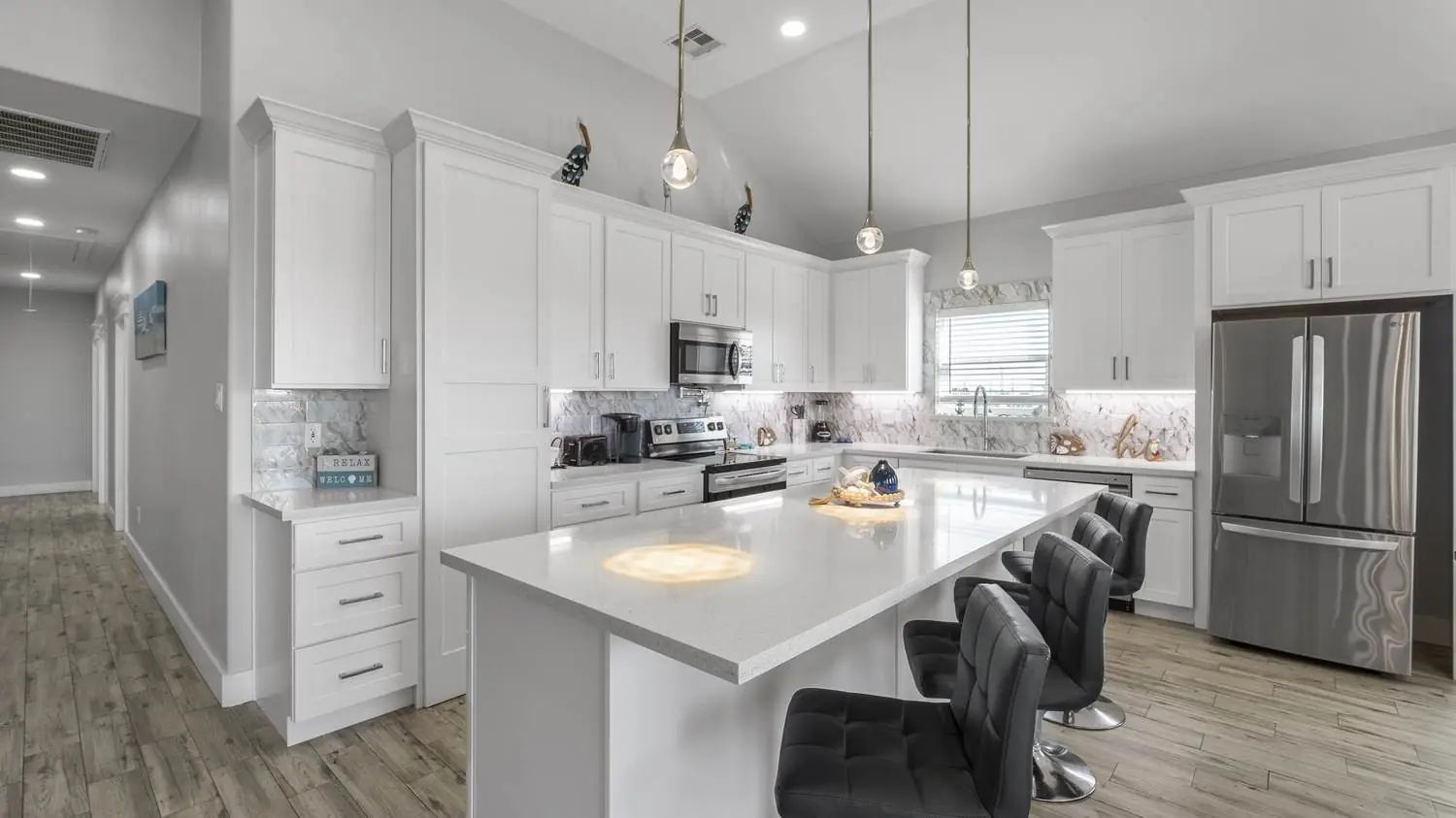
The kitchen is the room buyers judge first and the room sellers most often leave half-ready. We photograph a lot of them, and the same handful of problems come up again and again — all of them fixable in ten minutes, none of them fixable in editing.
Here is what goes wrong most often.
1. Leaving the counters working
This is the big one. A kitchen that is being lived in — knife block, toaster, kettle, paper towel holder, the fruit bowl, the mail — photographs as cluttered even when it is perfectly tidy in person. The camera flattens depth, so objects that read as separate when you are standing in the room merge into visual noise in a photograph.
What to do instead: clear the counters entirely, then put back one or two considered items. A bowl of lemons, a single plant, a folded cloth. The goal is a surface that looks usable rather than used.
2. Forgetting the fridge
Magnets, school photos, invitations, the calendar, the kids’ drawings. A refrigerator door covered in personal items does two things at once: it adds clutter, and it makes the house feel like it belongs to someone specific. Buyers need room to imagine themselves there.
What to do instead: strip the fridge completely. Nothing on the door, nothing on top.
3. Mixed bulb colour
This one surprises people. If the recessed lights are cool white, the pendants are warm and there is daylight coming through a window, the photograph will have three different colour casts in it. Warm pools under the pendants, blue-grey under the cans.
Editing can correct an overall colour cast. It cannot easily correct three different ones in the same frame without the whole image starting to look artificial.
What to do instead: match the bulbs. Replacing three pendant bulbs so they match the recessed lighting takes five minutes and makes a visible difference. Replace anything burnt out while you are there.
4. Dish racks, sponges and soap
The sink area accumulates the least photogenic objects in the house — washing-up liquid, a sponge, a scrubbing brush, a drying rack, a damp cloth over the tap. They are small, and they sit at exactly the height the camera notices.
What to do instead: everything in a cupboard. Including the bin, if it is a free-standing one that lives next to the island.
5. Fingerprints on stainless steel
Stainless appliances show every mark, and they show them more in a photograph than in person because the camera picks up the reflection of the window. A fridge door that looks fine while you are walking through will photograph covered in handprints.
What to do instead: wipe down every stainless surface with a microfibre cloth on the morning of the shoot. Fridge, oven, dishwasher, hood, tap.
6. Bar stools left at angles
Small thing, disproportionate effect. Stools pushed in at inconsistent angles read as untidy in a wide frame, and because they sit in the middle of the composition the eye goes straight to them.
What to do instead: push them all fully in, evenly spaced, facing the same direction.
7. Over-styling
The opposite failure, and more common than it used to be. A cutting board with a bottle of olive oil, a bowl of artfully arranged produce, a cookbook propped open, a vase of flowers, a tea towel draped just so — all on the same three feet of counter.
Staging should look like someone keeps a nice kitchen, not like a photoshoot happened. When every surface has a vignette on it, buyers stop believing the photograph.
What to do instead: one focal point per surface, maximum. Then remove one more thing than you think you should.
8. Not opening the blinds — or opening them inconsistently
Kitchens are often the brightest room in a Houston home, and natural light is doing most of the work in the photograph. Closed blinds flatten everything. Blinds at four different heights across one wall is worse — it is immediately visible in a wide frame.
What to do instead: open everything, all to the same height.
What editing can and cannot fix
Worth being explicit, because the assumption that it can all be fixed afterwards is what leads to half-prepared kitchens.
Included in every photo at no charge: HDR processing, sky enhancement, colour correction, vertical line straightening.
Available as an add-on: object removal at $25 per image. That covers one or two specific items, not a counter full of them.
Not fixable: clutter, personal items, dirty surfaces, burnt-out bulbs, mixed lighting. Removing a kitchen’s worth of clutter convincingly is manual work that often is not possible at all, and it never looks as good as an empty counter did.
We photograph the home as we find it — we do not move furniture or clean. Ten minutes of preparation in the kitchen will do more for the listing than anything that happens afterwards.
Our full home prep checklist covers every room and is written to be forwarded straight to a seller.
Need this on a listing? We cover the Greater Houston Area and deliver photos the next business day.
Questions? Call (713) 487-6301 or email info@elev8images.com.